Showing posts with label Problem. Show all posts

Saturday, September 21, 2013

Hey, Fat Cats! Vets Say Pet Obesity Is A Growing Problem


Hey, Fat Cats! Vets Say Pet Obesity Is A Growing Problem


fat-cat-overweight
Getty Images


You’ve heard about the obesity epidemic, but did you know it’s affecting Fido and Frisky too? More than half of American dogs and cats are overweight, and one-quarter are obese, but their owners don’t have a clue.


In fact, many owners say they find their fat friends “cute,” according to a survey by the Association for Pet Obesity Prevention.


The survey of vets found 53% of adult dogs and 55% of cats to be classified as overweight or obese by their veterinarian, an increase over 2010, which means pet obesity is a growing problem.


Currently, a whopping 88.4 million pets are too heavy for their size. While a chubby cat or dog might be cuddly, vets say excess weight leads to health problems including arthritis, diabetes, and other chronic conditions normally associated with human obesity.


Other highlights from the survey:


  • A 95-pound male Golden retriever is comparable to a 5’4” human female weighing 184 pounds or a 5’9” male that weighs 214 pounds.

  • A 10-pound Chihuahua is comparable to a 5’4” human female weighing 242 pounds or a 5’9” male that weighs 282 pounds.

  • A 15-pound domestic short-haired cat is comparable to a 5’4” human female weighing 218 pounds or a 5’9” male that weighs 254 pounds.

  • A premium pig ear (231 kcals) fed to a 40-pound dog is the equivalent of an adult human drinking six 12-ounce Coke Classics (840 kcals).

  • A typical dog biscuit (25 to 27 kcals) fed to a 20-pound dog is the equivalent of an average adult human eating two Keebler EL Fudge Double Stuffed Sandwich Cookies (180 kcals).


Read more about pet health:


Friday, September 20, 2013

Does your pet have a drinking problem?


RSS


Fresh, clean water is vital to your pet’s health and if he’s not getting enough now, how will he stay hydrated in the summer sun?


Importance of hydration


About 80% of your pet’s body is made up of water. This water is essential for caring out vital processes such as circulation and digestion. To keep these processes running smoothly a typical pet will drink about an ounce of water per pound of fat a day. However, depending on his level of activity and the amount of time spent outside, in the summer he may drink up to 3-5 ounces per pound of fat. Losing as little as 5% of body water can slow down the vital processes keeping him alive and losing 10% can begin to shut them down.


Now that you know why hydration is important, how can you get him to drink more water.


How to stay hydrated


The easiest way to keep your pal hydrated is to give him access to fresh, filtered water. Studies have shown that pets are enticed to drink more when they are presented with fresh, filtered water. An easy way to give your pet filtered water is by using a Drinkwell fountain. By using a patented free-falling stream of water, the Drinkwell fountain continually aerates your pet’s water with healthful oxygen.  An extra-large charcoal filter removes bad tastes and odors, giving your pet the best possible, and most appealing, way to stay hydrated!


A gravity water system, like the Healthy Pet Water Station, is also a great solution to your pet’s water needs. Gravity systems are like water coolers at work. Water flows from the system’s water jug into your pet’s bowl giving him the water he needs, when he needs it. Plus, you can buy water filters for many of the gravity systems allowing your dog more cleaner, healthier water.


If your pet is still not getting enough water and he eats dry food, you may want to switch to wet food when it is hot out. Wet food has most moisture than dry so he’ll be getting more water from his food. If your dog is able to eat wet food and you can afford to switch over for a few months, you may find that your dog is able to stay hydrated longer.


Finally, you can keep him hydrated by keeping him cool. Let your pet enjoy the great outdoors in the morning, early afternoon or as the sun begins to go down. It is typically the hottest from noon to about 4:30 p.m. The hotter it is, the fast he will dehydrate.


Even if your pet stays indoors all day, he is still at risk. To save money on the electric bill, most people don’t leave their AC on all day. If your pet is at home while your air conditioning is off, make sure you give him some way to stay cool. Whether you time your unit to turn on throughout the day or keep your pet in a room with fans, spending a few extra dollars each month to make sure your pet isn’t over heating is cheaper than the medical bill you’ll have to pay if he does.


Signs of dehydration


Even if you think your pet is getting enough water, he could still become dehydrated. Look for signs of lethargy, sunken eyes, loss of appetite, dry mouth, depression and diarrhea. Take your pet to the vet immediately if you see these signs or believe your pet is dehydrated.


If your dog is not overweight or very skinny there is an at home test you can do to get a better idea of whether or not your pet is dehydrated. Gently lift the skin on the back of your dog’s neck or between the shoulder blades. The skin should immediately return to its normal position.  Dehydration takes away some of the skin’s elasticity so if your pet is dehydrate the skin should stay bunched instead of going back to it’s normal position.  However, if your pet’s skin does go back down and he is showing the systems listed above, it is crucial that you get him to a vet.


Photo by Michelle Feldman


Monday, September 16, 2013

New Solution To An Old Problem For Dogs With Mobility Issues

by Dr. Julie Buzby


The clinic, where I work part time, holds an annual open house each December.  Last year I was manning my “Holistic Veterinary Care” station, chatting with clients and sipping hot cocoa, when my imagination was captured by the simplest idea. 


Naturally, at a veterinary hospital open house, pets are welcome. I had treated Morgan, one of our technician’s dogs, a few times and was happy to see her headed my way across the parking lot sporting a festive bandana. Accompanying her was the technician’s husband Todd, who is the closest thing I’ll ever meet to Leonardo DaVinci. 


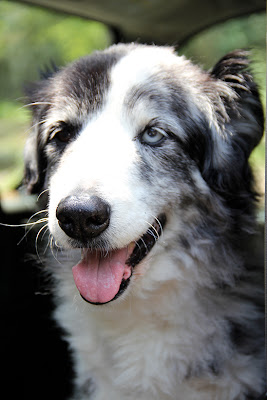
“Look what I did for Morgan,” were his first words.  He pointed at her furry Aussie paws and smiled.


I took one look at her toenails and goosebumps covered my arms. Todd had concocted rubber rings for Morgan’s nails which I inherently understood would give her traction.


I was awestruck because a dog’s natural mechanism for traction is to flex the paws and engage the nails. 


Yet never before had anyone considered traction from the standpoint of the dog’s toenails. 


At 16-years old, Morgan had been struggling with instability and arthritis. And she lived in a home with exclusively hardwood floors. Morgan typified so many of my senior patients. As Todd shared what the grips had done for Morgan’s activity level and confidence, my mind raced with patients who could benefit from these little devices.


I called one client immediately and arranged for Hope, her 15-year old Shepherd mix, to try these “toe grips”.


A few days later, Kim and Hope pulled up to my house. “She’s having a bad day,” Kim called from the curb as she lifted Hope from the car. The 15-year old Shepherd mix hobbled down my driveway.


Hope had a knee surgery years earlier that had not healed correctly.  


As a result, she never put much weight on her right hind leg, and when she pushed off of it in normal stride, the leg always twisted out grotesquely. Sweet Hope flopped down obligingly in my driveway, while we put on her grips.


Then she stood up, and walked away 75% improved! 


My jaw hung. The only logical explanation was that when she bore weight on her bad leg and it didn’t twist out from under her because of the toe grips, she was willing to bear more weight on that leg. I’d seen Hope every 3 weeks for the prior two years. She was on every manner of Western and alternative medication/supplement and I treated her regularly with acupuncture and chiropractic. She was holding her own, but I could never affect the slipping and twisting of her leg.


It was a biomechanical problem, and the only solution I could suggest was throw rugs.  


But in less than 5 minutes (the time it took to apply them), toe grips revolutionized Hope’s posture and gait. 


In my driveway that day, as Hope explored my shrubs with a smile, “Dr. Buzby’s ToeGrips” was born.  


I knew we had to make ToeGrips available for senior dogs everywhere.  We applied for a patent and began manufacturing small quantities of ToeGrips to beta test on dogs across North America. Most of my coworkers had senior dogs that they hoped ToeGrips would help. Gus, a 15-year old Scottie, was one of those dogs.


The day Gus came for ToeGrips, he was carried up the stairs by Frank, one of our receptionists, who held his beloved companion while I applied the rings to his toes.  


I had never treated Gus before and had never watched him gait. So I didn’t understand why Frank became emotional when he set Gus down and the dog sauntered away across my hardwood floors. He was walking, even occasionally jogging. Frank explained to me that Gus had not walked that normally for years.


Now, when Gus comes to visit, he runs up the flight of 13 steps to my front door!


In all three of these dogs–Morgan, Hope, and Gus–the owners reported the initial, instant improvement, but also a cumulative improvement over time. At first, I thought this might be because the dogs were using themselves more correctly and building muscle. But then I received an email from a vet in New England who’d tried them on a patient and reported, “Interestingly enough, ToeGrips help this dog on any surface.


We think this is because they are providing proprioceptive stimulus.”  


And a lightbulb went on for me. Proprioceptive stimulus is perhaps the most critical mechanism by which ToeGrips help dogs.


They actually affect the brain, stimulating it to pay more attention to the paws. 


Since our website went live August 22nd, we’ve shipped ToeGrips to 42 states and 5 countries. I recommend ToeGrips as an integral part of the multimodal approach to senior pain/mobility management.


ToeGrips are a biomechanical solution to a biomechanical problem!  


They were designed for slipping/weak senior dogs, but may also be helpful for disabled and rehabilitating dogs. When I read testimonials from dog parents around the world, explaining how ToeGrips have profoundly improved their dog’s quality of life, I STILL GET GOOSEBUMPS! 


Here’s one of my favorites:  https://www.youtube.com/watch?v=F-IdweUMGtQ


***


Dr. Julie Buzby is a homeschooling mom of seven, AVCA & IVAS certified holistic veterinarian, and passionate advocate for canine mobility.  She can be reached at drbuzby@toegrips.com or Twitter @drbuzby.

Learn more about Dr. Buzby’s ToeGrips at www.toegrips.com and www.facebook.com/toegrips.